





From Pro-Democracy Activist to Cotton Censorship
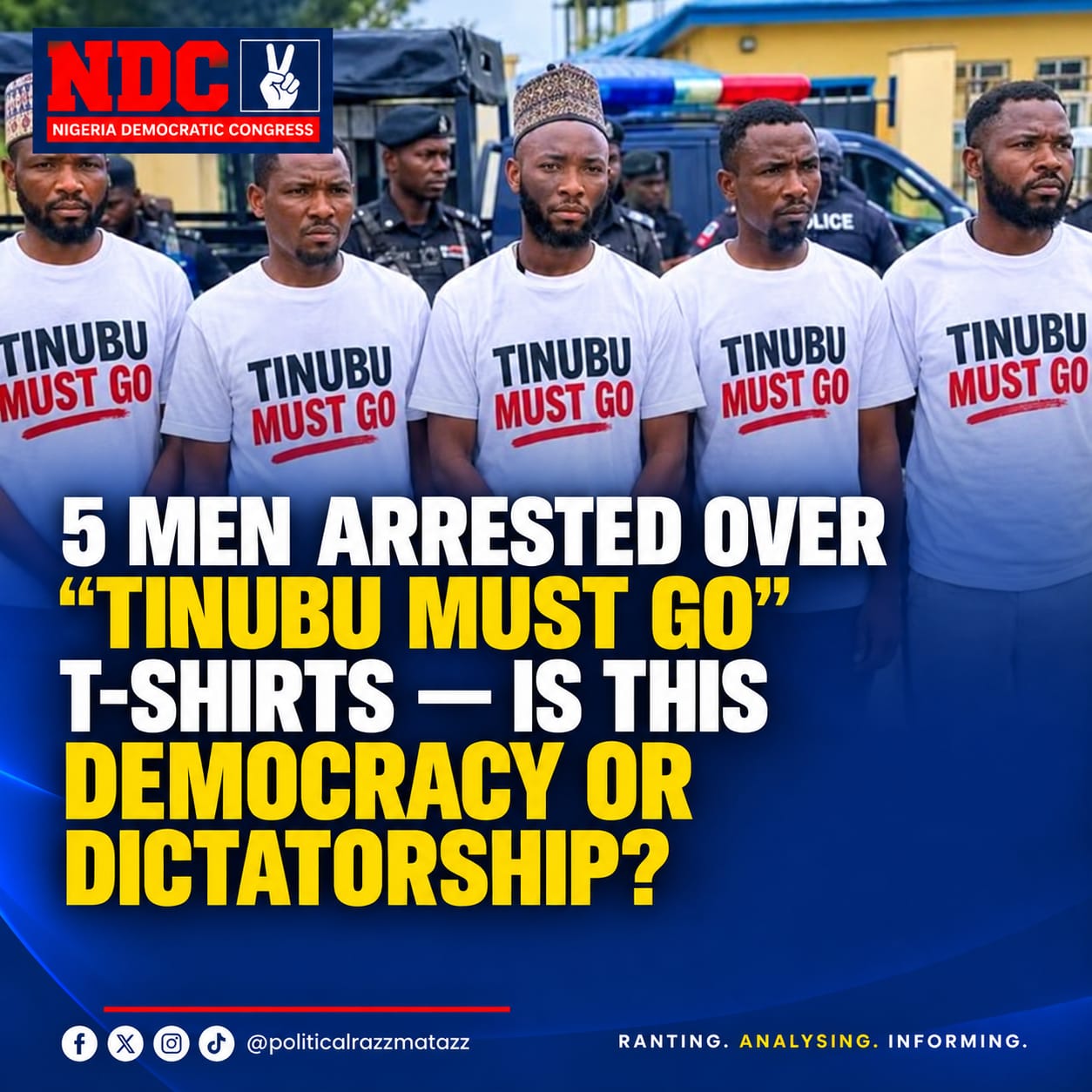
In a democracy, the line between robust political dissent and criminal conduct is supposed to be crystal clear. But in Maiduguri, Borno State, that line was erased when five citizens found themselves handcuffed, dragged before a magistrate, and remanded in custody for the simple act of printing and wearing cotton T-shirts bearing the words “Tinubu Must Go.”
The five men—identified in the police First Information Report as Baba Aji Gremami, Mustapha Abba Yemen, Abbacha Mohammed Ali, Adam Umar Gubio, and Abdulhamid Mohammed—pleaded not guilty to charges of criminal conspiracy, inciting disturbance, disturbance of public peace, and thuggery.
As reported in the Daily Post’s coverage of the Maiduguri arrests and confirmed by The Whistler’s report on the court remand, the state apparatus treated ordinary apparel with the severity typically reserved for armed mutiny.
Since when polo shirt turn into AK-47? When citizens expressing their dissatisfaction with governance are slammed with thuggery charges for wearing printed fabric, the democratic space is no longer just shrinking; it is suffocating.
Cotton Is Not a Weapon: Amnesty International Steps In
The arrest drew condemnation from human rights watchdog Amnesty International, which demanded the unconditional release of the five detainees.
As detailed in Leadership’s report on Amnesty International’s condemnation, the rights organization emphasized that expressing political opinions through clothing cannot, under any legal stretch, be treated as a criminal offense. Amnesty reminded security agencies that the right to demonstrate political preference or voice disapproval does not belong exclusively to ruling party loyalists.
Section 39 of the 1999 Constitution explicitly guarantees every Nigerian the right to freedom of expression, while Section 40 protects the freedom of peaceful assembly and association.
To classify a printed slogan as “criminal conspiracy” and “thuggery” is an abuse of legal terminology:
- No Violence Occurred: The men were not carrying weapons, blocking traffic, or destroying public infrastructure.
- Double Standards in Uniform: When supporters print matching Ankara fabrics and caps emblazoned with ruling party slogans, police escorts clear the highway for them. But the moment an opposition youth wears a shirt expressing disaffection, sirens wail and handcuffs appear.
- The True Meaning of Thuggery: Thuggery involves violence, intimidation, and physical harm. Printing a critical slogan on a shirt is the definition of peaceful civil expression.
If police begin arrest people because cloth write wetin dey pain dem, then market women wearing black to protest hunger fit be the next batch for detention cell.
The Bitter Irony of Bola Tinubu’s Journey
What makes this incident unsettling is the political journey of the man occupying Aso Rock.
President Bola Ahmed Tinubu did not climb to power through silent subservience to authority. In the dark days of the 1990s military dictatorship, he was a key figure in the National Democratic Coalition (NADECO), risking his personal liberty and living in exile while demanding that military rulers vacate power.
Even in Nigeria’s civilian era, Tinubu was at the forefront of aggressive opposition politics. During the 2012 “Occupy Nigeria” protests against fuel subsidy removal under the Goodluck Jonathan administration, opposition figures mobilized rallies, waved banners, and demanded that the government reverse course. Jonathan did not dispatch state prosecutors to charge demonstrators with criminal conspiracy for holding placards.
How does a veteran of pro-democracy street activism become the commander-in-chief under whose watch five young men are thrown into custodial cells for wearing shirts calling for his constitutional exit?
Power often alters political memory, but this transformation is stark. When a government that traces its ideological roots to protest begins criminalizing peaceful dissent, it betrays the civic struggles that made civilian rule possible in 1999.
What Freedom Remains Ahead of 2027?
This episode in Maiduguri is not an isolated courtroom proceeding; it is a test balloon for the 2027 general elections.
If security agencies establish the precedent that declaring a president should step down is treasonous or disruptive to public peace, then political campaigning has been effectively outlawed for everyone outside the ruling party.
The bedrock of any constitutional republic is that leaders serve at the pleasure of the electorate. Demanding that an elected official leave office—whether through the ballot box, public debate, or symbolic protest—is the primary right of the citizen. It is the ruling party’s duty to persuade voters with performance, not to unleash the police to strip shirts off opposition backs.
The Real Question for Nigerians
The arraignment of these five men in Borno cuts straight to the core of Nigeria’s democratic identity. If citizens cannot express peaceful opposition to a sitting president without facing police cells, what is left of our democracy?
- Is this the democracy Nigerians fought and bled for during the military era?
- Should the Inspector-General of Police drop the charges against these five young men immediately?
- Where do you draw the line between legitimate national security and the clampdown on free speech?
Share your candid thoughts, legal perspectives, and reactions in the comments below!