





The Beautiful Bride of Nigeria’s Democracy
In a political climate where the ruling All Progressives Congress (APC) appears determined to bulldoze all dissent and push Nigeria toward a de facto one-party state, genuine institutionalists who defend the sanctity of the constitution across partisan divides are becoming rare national treasures.
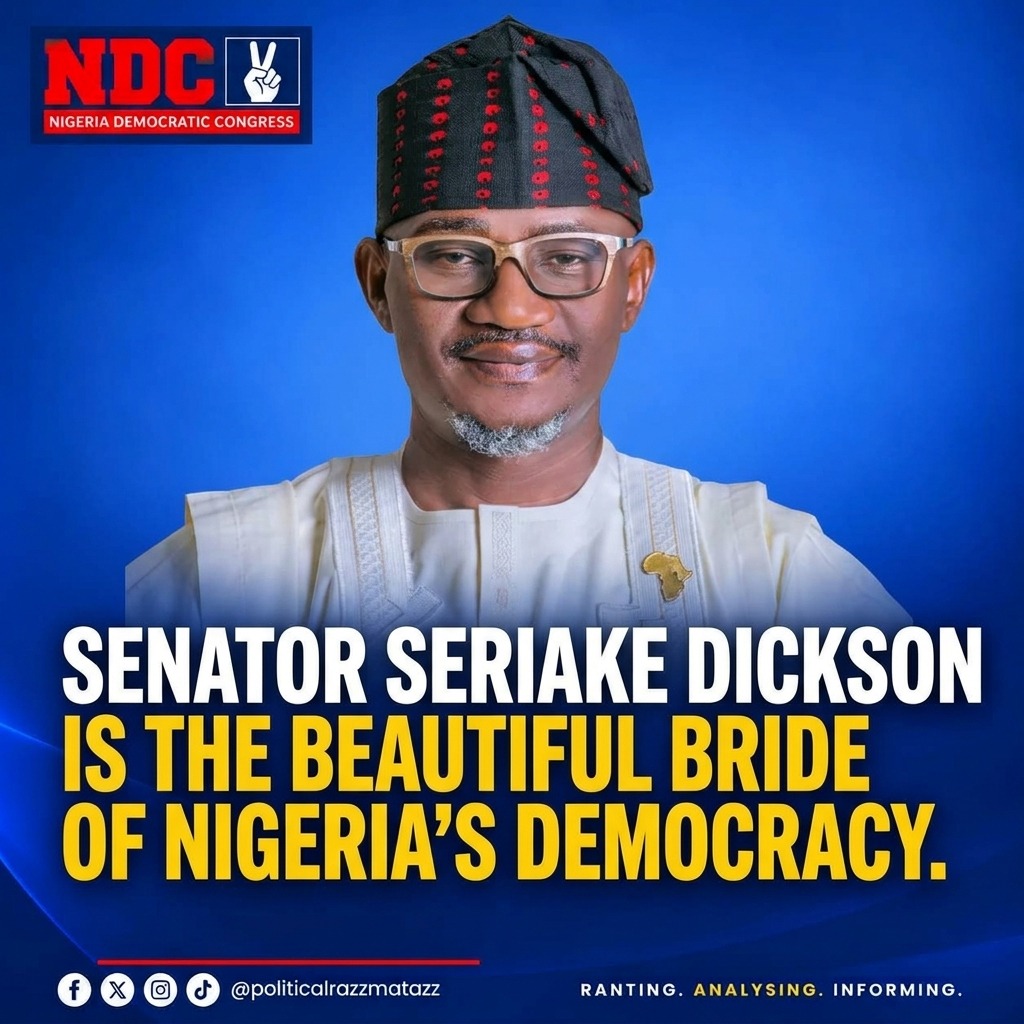
That rare status was captured in clear terms by Comrade Daniel Onjeh, the Benue South Senatorial candidate of the Nigeria Democratic Congress (NDC) and former President of the West African Students’ Union (WASU). Reflecting on the evolving battle for Nigeria’s political soul, Onjeh described NDC National Leader and former Bayelsa State Governor, Senator Henry Seriake Dickson, as the “beautiful bride of Nigeria’s democracy.”
As detailed in Vanguard’s report on Onjeh’s remarks, the former student activist turned politician praised Dickson’s courage of conviction, emphasizing that the Bayelsa West lawmaker has consistently placed constitutional governance and democratic integrity above fleeting partisan convenience.
For our political terrain where most politicians dey change mouth according to where bread butter pass, leader wey dey stand ground on top principle na pure gold.
Beyond Partisan Convenience: A Legacy of Constitutional Courage
What makes Onjeh’s endorsement compelling is that it is not rooted in recent campaign camaraderie. Drawing from his own background as an activist and long-time public commentator—documented on Daniel Onjeh’s public profile—the Benue South candidate revealed that his deep respect for Dickson’s democratic instincts began years ago, when both men were on opposing political divides.
Onjeh recalled Dickson’s principled opposition to the controversial clamour for the suspension of elected officials during the Rivers State political crisis. While others in the political class were cheering executive overreach for partisan gain, Dickson—then sitting on the opposite side of the aisle—spoke out against the unconstitutionality of truncating democratic mandates through backroom emergency declarations.
To Dickson, defending the rule of law was not an exercise in defending one’s friends; it was about protecting the institutional framework that prevents Nigeria from tumbling into administrative tyranny. That willingness to take an unpopular, principled stance earned him cross-party respect across the Middle Belt and the wider federation.
Building the NDC: Rescuing the Multiparty Space
The celebration of Dickson as democracy’s “beautiful bride” comes at a critical juncture for the republic. With traditional opposition structures crippled by internal sabotage and the ruling APC administration presiding over record-high fuel prices, crushing food inflation, and the alarming suppression of peaceful civic expression, millions of Nigerians had begun to despair over the future of competitive politics.
Dickson understood early that surrendering to the ruling platform would sound the death knell for Nigeria’s fourth republic. Rather than taking the easy road of defection, he invested enormous political capital into establishing and nurturing the Nigeria Democratic Congress (NDC).
Within a relatively short period, the NDC has transformed from an ambitious reform movement into a nationwide platform capable of challenging the status quo. By attracting seasoned reformers across the geopolitical spectrum—from the Middle Belt to the Niger Delta, the North, and the South East—Dickson’s foresight has provided a credible political umbrella for citizens demanding genuine governance alternatives.
Sustaining the Fire: Grassroots Consolidation Ahead of 2027
However, building an alternative platform is only the first phase. As Onjeh rightly observed, the true test lies in transforming national momentum into impenetrable grassroots strength.
“The fire has been lit, and the momentum is encouraging,” Onjeh pointed out, urging Dickson and the party leadership to sustain the tempo. “What is required now is to keep it burning, consolidate the structures already built from the grassroots upwards and continue earning the confidence of Nigerians.”
For the NDC to defeat the entrenched machinery of the ruling establishment in 2027, the party must continue to anchor its appeal in the wards, local government secretariats, and rural communities:
- Deepening Internal Democracy: Ensuring that candidate selection and party decisions reflect transparent consultation rather than elite godfatherism.
- Consolidating Grassroots Alliances: Uniting trade unions, women’s cooperatives, student bodies, and agricultural collectives disillusioned by escalating economic hardship.
- Defending the Ballot: Training dedicated polling unit agents capable of resisting electoral manipulation and protecting voter mandates on election day.
As the race toward 2027 accelerates, the emergence of a robust, principled opposition is no longer just about winning seats—it is an existential requirement to ensure that Nigerian democracy remains vibrant, competitive, and accountable to the people.
Can a Stronger Opposition Rescue Nigeria’s Democracy?
Comrade Daniel Onjeh’s tribute to Senator Seriake Dickson raises an urgent question for every Nigerian voter: without a principled, unyielding opposition standing as a check against executive overreach, can our democracy survive the current socio-economic storm?
Do you believe Senator Seriake Dickson and the NDC have created a credible alternative capable of defeating the APC in 2027? What must opposition platforms do right now to earn the lasting trust of everyday Nigerians?
Drop your candid perspectives, political analyses, and thoughts in the comments below!