





Why the NDC Is Advising Nyesom Wike to Draft His Resignation Letter
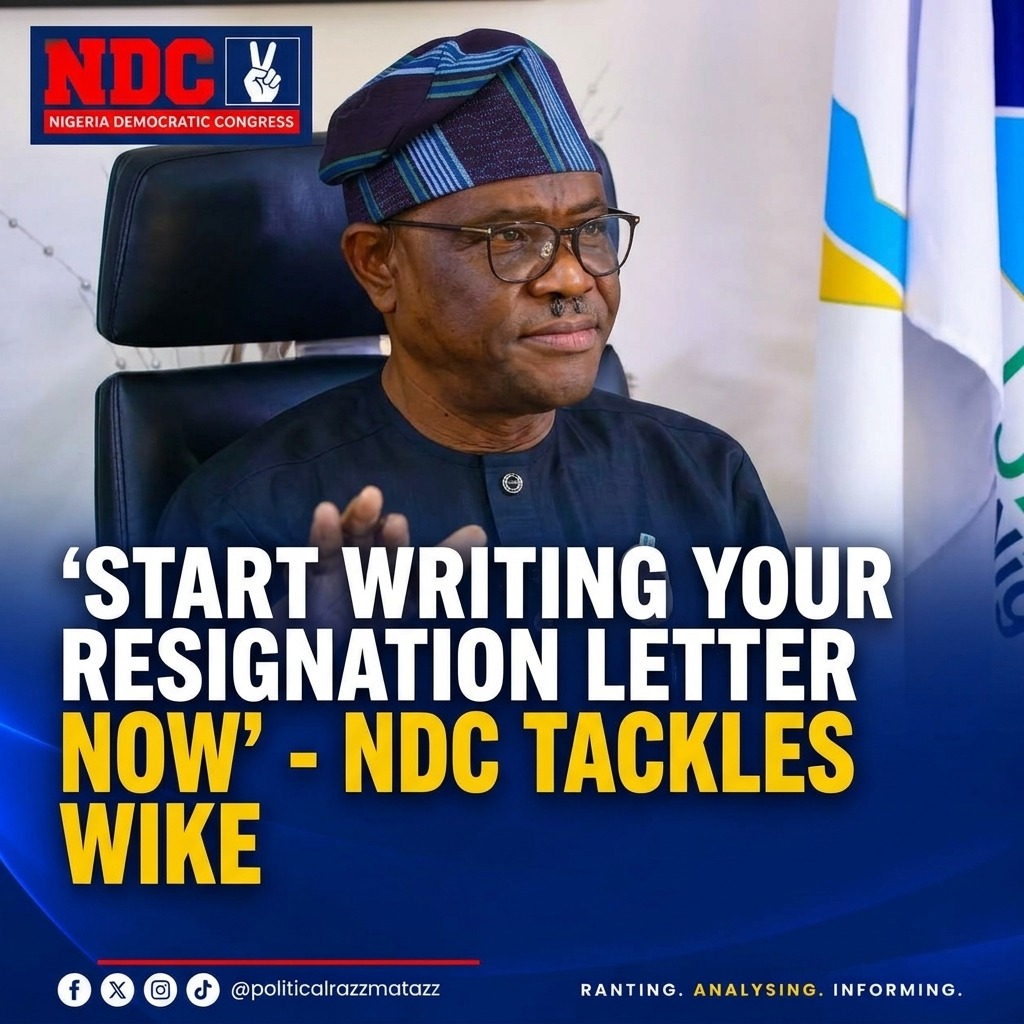
When political leaders start confusing executive authority with absolute ownership of the electorate, Nigerian democracy has a way of serving up a harsh reality check.
Addressing members of the Apo Traders Association in Abuja, the Minister of the Federal Capital Territory (FCT), Nyesom Wike, staked his entire cabinet career on the outcome of the next general election. According to reports by Premium Times on Wike’s resignation vow and confirmed by Channels Television, the minister boldly declared that if President Bola Ahmed Tinubu loses either Rivers State or the FCT in the presidential election scheduled for January 16, 2027, he will formally tender his resignation on January 17.
The reaction from the opposition was swift and merciless.
Firing back at the minister’s boast, the Nigeria Democratic Congress (NDC) dismissed his pronouncement as textbook political arrogance, advising him to stop waiting until January 2027 and start writing his resignation letter right now.
For Naija politics, we don hear plenty boast, but treating millions of independent voters like personal parcel wey one man fit “deliver” na another level of delusion. In 2027, it is the ordinary citizen with a permanent voter card—not any self-appointed godfather—who will have the final say.
Voters Are Not Cargo: The Myth of Political Monopolies
At the core of the NDC’s rebuttal is a foundational democratic truth: no individual owns the ballot box.
Wike’s rhetoric that he cannot afford to lose the FCT because “it is where I work” and Rivers State because “it is my home” exposes an outdated godfather syndrome that treats sub-national territories as personal fiefdoms. As analyzed in The Punch’s scrutiny of Wike’s electoral calculations, an election is not a commercial transaction where political merchants barter millions of human beings to curry favor with the presidency.
The democratic history of both territories points in the opposite direction:
- The FCT Rejecting the Status Quo: In the 2023 presidential election, the Federal Capital Territory demonstrated fierce civic independence by resoundingly rejecting the ruling All Progressives Congress (APC). Tinubu failed to secure even 25 percent of the votes in Abuja, with the electorate voting en masse for change.
- The Boiling Cauldron of Rivers State: Rivers voters have grown increasingly resistant to top-down political imposition. With public consciousness at an all-time high and lingering anger over the disputed 2023 collation exercises, the assumption that one politician can simply order the state to line up behind the ruling platform is a dangerous gamble.
Citizens are not cargo. When a minister boasts about guaranteeing votes before a single ballot is cast, it raises legitimate worries about what electoral machinery he intends to deploy against the democratic will of the people.
The Economic Reality on the Streets of Abuja and Port Harcourt
Beyond political arithmetic, there is the brutal reality of daily life in Nigeria today.
Can any political actor, regardless of his microphone bravado, convince the average Nigerian that life has improved under the APC-led administration?
- The Fuel Nightmare: With commercial petrol stations dispensing fuel above ₦1,300 and ₦1,400 per litre, transport fares in Abuja and Port Harcourt have crippled family budgets.
- Cost-of-Living Squeeze: Market traders in Apo, civil servants in Garki, artisans in Mile 1, and small business owners in Diobu are struggling under hyperinflation that has reduced real incomes to dust.
- Clampdown on Freedoms: Citizens are watching an administration that promised renewed hope preside over custodial tragedies in Minna and police tear-gassing peaceful processions in Uyo.
Belly wey dey hungry no dey listen to campaign grammar. The traders in Apo whom Wike addressed are paying astronomical bills for logistics, diesel, and basic commodities. Claiming that infrastructure projects in the city center will automatically wipe away national economic misery at the ballot box is wishful thinking.
The NDC Factor: An Opposition Built on Principle
The NDC’s confidence in taking both the FCT and Rivers State is not rooted in bravado; it is driven by an organized, disciplined movement for systemic reform.
Under the principled leadership of figures like former Bayelsa State Governor Senator Henry Seriake Dickson—who famously chose to build a multiparty democratic alternative rather than surrendering to the ruling establishment—and the national coalition anchored by Peter Obi and Rabiu Kwankwaso, the NDC represents an unyielding challenge to political monopolies.
By prioritizing transparent party structures, respecting voter sovereignty, and mobilizing at the ward and polling-unit levels, the NDC is building a fortress in both the South-South and the nation’s capital. When voters are offered a credible, production-centered alternative against administrative failure, political strongmen quickly discover the limits of their influence.
The Ballot Box Will Settle the Argument
Minister Nyesom Wike has laid his cards on the table, staking his political survival on two territories that are hurting under the weight of prevailing economic hardship.
History has repeatedly shown that whenever politicians become overconfident and take the electorate for granted, the ballot box delivers an unmistakable verdict. January 2027 is coming, and when the voters of the FCT and Rivers State step into the voting booths, no amount of executive swagger will substitute for the sovereign choice of the people.
Wike might want to keep that resignation pen handy.
What Do You Think?
Can Nyesom Wike actually “deliver” both the FCT and Rivers State to President Bola Tinubu in 2027, or are the voters in both territories ready to hand him his resignation letter? How do you see the Nigeria Democratic Congress (NDC) performing in Abuja and the Niger Delta?
Drop your candid thoughts, political predictions, and analyses in the comments below!