




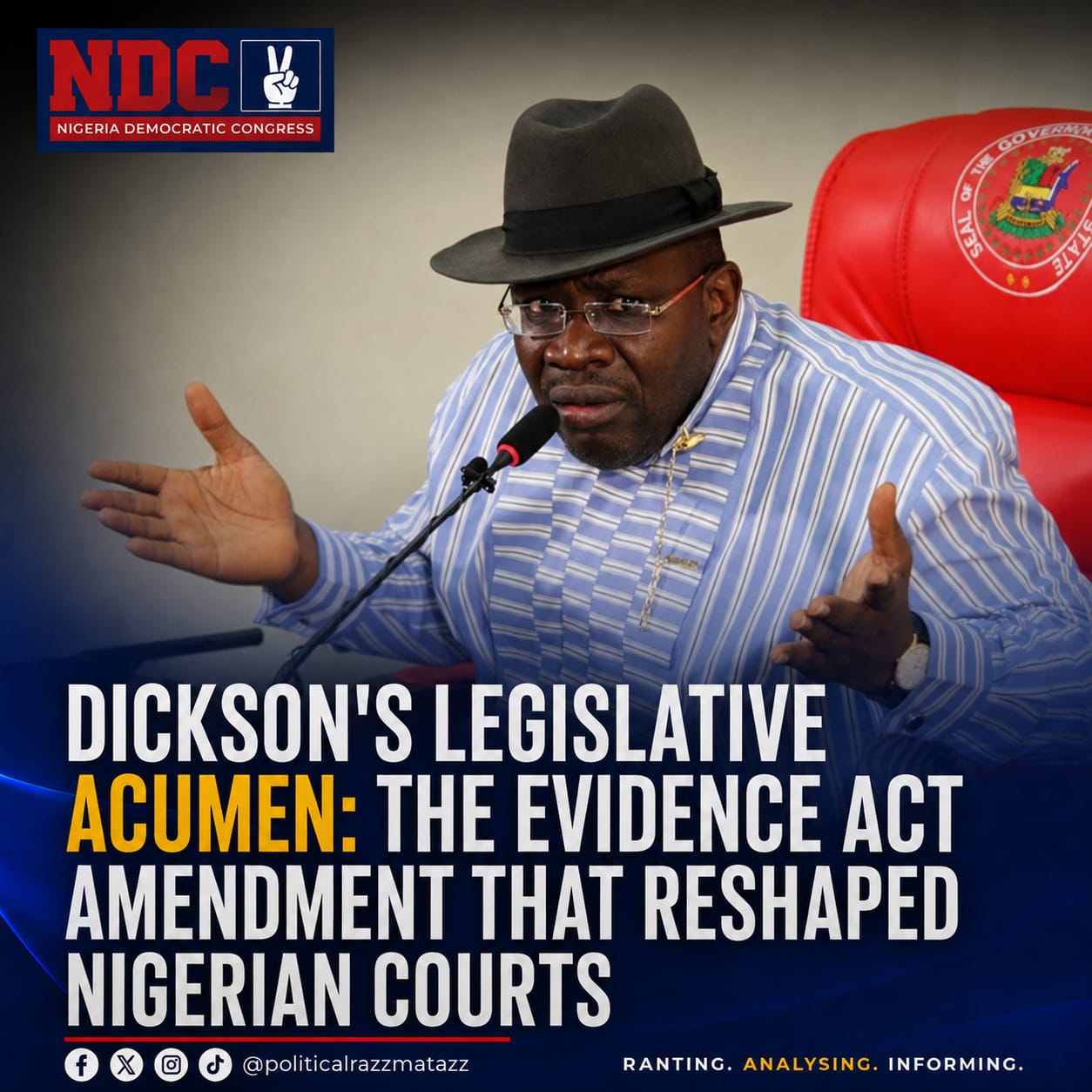
Dickson’s Legislative Acumen: The Evidence Act Amendment That Reshaped Nigerian Courts
(By The Political Razzmatazz Editorial Team | Legal & Governance)
Long before his years as the Governor of Bayelsa State or his time as a Senator drew national attention, Henry Seriake Dickson was already leaving a massive mark on Nigeria’s legal architecture.
As a member of the House of Representatives, he sponsored the highly impactful Evidence Act (Amendment) Bill of 2009. This was a historic move, as it marked the very first major amendment to the Act since 1954.
Here is a closer look at how this single piece of legislation completely changed the Nigerian legal system.
A Massive Update After Five Decades
For over five decades, the legal framework guiding how evidence was admitted in Nigerian courts had remained entirely untouched. The old laws were simply no longer in tune with the realities of modern society and changing technology.
Dickson recognized this massive gap and pushed for a critical reform. His amendment successfully modernized the rules of evidence, making the legal system far more efficient and relevant to the 21st century. The push for this reform ultimately paved the way for the comprehensive Evidence Act of 2011, which formally repealed the outdated laws and introduced new rules, including the admissibility of computer-generated and electronic evidence.
Why This Matters Today
The impact of this reform cannot be overstated. It changed the daily operations of lawyers, judges, and the entire justice system.
Today, legal scholars and practitioners cite the amendment extensively. In fact, several academic works and legal research papers have been written specifically to study its impact.
For a lawmaker, having a single piece of legislation become the foundation for such widespread academic and practical legal work is a very rare and prestigious distinction. It stands as clear proof of Dickson’s deep legislative acumen and his long-lasting contribution to Nigeria’s justice system.
What are your thoughts on this historic legal reform? Let us know in the comments section below!